From the X archive · August 19, 2026
Epistemology, Bureaucratic Consensus, and the Limits of Materialist Models
Abstract
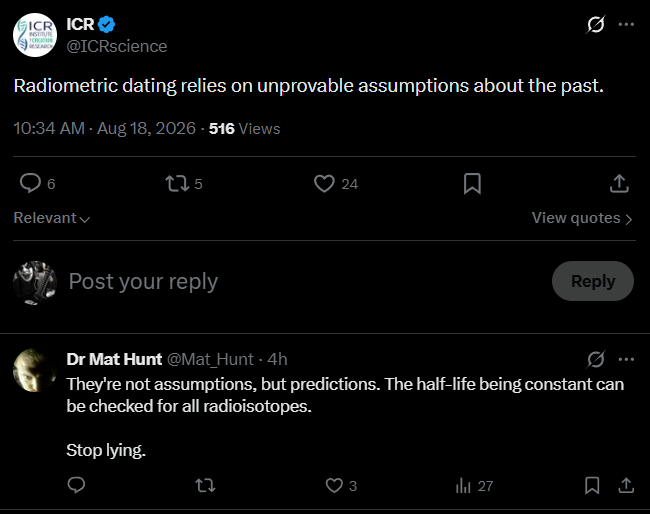
This paper is my direct reaction to the standard materialist play—specifically exemplified by Dr. Mat Hunt (@mat_Hunt) dismissing a testing procedure criticism raised by the Institute for Creation Research (@icrscience) on X.com. It explores the systemic breakdown in communication between institutional materialist science and alternative structural/empirical critiques. By tracing my own inquiry—starting with the glaring flaws in Earth-age arguments and carbon dating methodologies, and progressing through physical anomalies like the Shroud of Turin, ancient textual checksums, and the commercial evolution of language—I demonstrate how procedural compliance regularly replaces the search for actual ontological truth.
1. The Core Paradox: Process vs. Reality
My critique begins with a simple observation: the mainstream scientific consensus surrounding radiometric dating and the age of the Earth relies on fundamentally garbage, circular arguments. I am not coming at this as a Young Earth ideologue, but when I look at how materialists defend their timeline, I see an unassailable double standard.
Case in point: Dr. Mat Hunt’s reflexive dismissal of ICR’s procedural criticism on X. Materialists treat carbon isotope dating as an untouchable, absolute truth. In reality, carbon dating is merely one isolated piece of circumstantial evidence that might mean something—if its foundational assumptions hold.
The fundamental hypocrisy lies in two unprovable axioms that materialist science treats as settled law:
- The Assumption of Uniformity: It assumes that decay rates, atmospheric C-14 ratios, and environmental inputs have remained completely constant across thousands or millions of years without catastrophic disruption.
- The Absence of Eyewitnesses: Nobody was there. You cannot calibrate an unobserved past with absolute certainty using present-day processes without engaging in circular reasoning.
When institutional frameworks encounter these foundational vulnerabilities, they default to a legalistic, procedural defense:
- Procedural Truth: Evaluating whether an experiment followed orthodox academic protocols, peer-review consensus, and accepted baseline models.
- Ontological Truth: Determining what actually happened in physical reality, regardless of whether current models or institutional gatekeepers can accommodate it.
When a framework privileges its own internal rules over direct physical evidence and unprovable assumptions, it ceases to function as a tool for discovery. It becomes an engine for paradigm defense.
2. Testing the Boundary Conditions: Physical Anomalies and Structural Invariants
To demonstrate where these materialist models hit a wall, I focus on physical and textual phenomena that completely defy standard procedural explanations:
-
The Physical Image Problem (Shroud of Turin): Stripping away theological assumptions, I look at the physical object as a pure engineering paradox: a 3D-mapped, non-pigmented, ultra-shallow (~200 nm) surface oxidation layer. Standard equilibrium thermodynamics offers zero plausible mechanisms for creating such an imprint without scorching the core fibers or causing chemical bleeding. Using a single, questionable carbon-14 test to hand-wave away the entire physical mechanism of the imprint proves my point: materialists use procedural shortcuts and bad isotopic assumptions to run away from uncomfortable physical anomalies.
-
Textual Invariants and Information Theory: Modern commercial languages like English are optimized for transactional trade, generalization, and market utility. Conversely, ancient alphanumeric systems like Hebrew and Koine Greek possess intrinsic mathematical geometry. My own analysis shows that interlocking structural checksums connecting texts like Genesis 1:1 and John 1:1 reveal fixed mathematical patterns—patterns that immediately degrade into random noise when forced onto arbitrary literature like Moby Dick. Dismissing these fixed-rule invariants as "numerology" without running control-tested probability models is the exact same procedural dismissal I see in the physical sciences.
3. Institutional Incentives and the Currency of Trust
I trace this procedural defense back to a fundamental issue of authority and incentives. Drawing a parallel to 1 Samuel 8 and Jeremiah 17:5, human-constructed systems—whether financial, governmental, or academic—inherently prioritize self-preservation and systemic control over absolute truth.
When society anchors its trust in external human authority and commercial utility, our language, algorithms, and scientific methodologies naturally adapt to protect institutional continuity. The instinct for figures like Dr. Hunt to dismiss anomalies or scoff at critics isn't about superior intelligence—it's an institutional defense mechanism. The system views unresolved anomalies and challenged assumptions as existential threats to its authority.
Conclusion
Challenging the standard, hand-waving arguments for Old Earth uniformitarianism or radiometric dating does not require adopting a simplistic alternative. Instead, it 'almost always' exposes a massive, glaring flaw in modern discourse: when mainstream science relies on procedural shields, unprovable assumptions about the past, and arrogance to protect its consensus, it forces independent thinkers like me to re-examine baseline assumptions across the board. True inquiry requires looking past the procedural verdict to measure physical, historical, and mathematical reality as it actually exists.